In the remote and hard-to-reach communities of the Greater Pibor Administrative Area (GPAA), seeking healthcare is often a painful journey marked by distance, fear, and uncertainty.
For many families, especially pregnant women, children, the elderly, and people living with disabilities, accessing the nearest health facility can mean walking for several hours through rough terrain, flooded areas, and insecure routes. In emergencies, these long journeys can become life-threatening.
South Sudan continues to face one of the most severe health crises globally. According to UNICEF, one in every ten children in South Sudan dies before reaching their fifth birthday, with malaria, pneumonia, and diarrheal diseases accounting for more than 75 percent of these deaths.
The country also has one of the highest maternal mortality rates in the world. The United Nations Population Fund (UNFPA) estimates that South Sudan records more than 1,150 maternal deaths per 100,000 live births, largely due to limited access to skilled healthcare during pregnancy and childbirth.
In many rural communities, health services remain extremely limited. Reputational report states that more than half of South Sudan’s population lives over one hour away from the nearest health facility, while only a small percentage of births are attended by skilled health workers
To help address these urgent humanitarian needs, CARE International, with funding from the South Sudan Humanitarian Fund (SSHF), is implementing a one-year project delivering safe, mobile, and inclusive integrated health services across four counties in GPAA. Through a mobile clinic approach, CARE is bringing essential healthcare services directly to communities in Boma, Maruwo, Kizingora, and Mewun Payams, significantly reducing the long and dangerous distances families previously travelled to access lifesaving treatment.
Each clinic is operated by at least eight health workers and three support staff under the supervision of a medical doctor. Services provided include outpatient consultations for all age groups, antenatal care (ANC), safe delivery services for pregnant mothers, referral of critical cases, facility based and vaccination outreach for children under five, nutrition and health education, mental health and psychosocial support, and clinical management services for survivors of rape.
In addition to providing essential healthcare services, CARE conducts regular community awareness sessions on the range of services available through mobile clinics. Before daily consultations begin, health teams engage community members in health education and awareness discussions, helping them better understand available services, disease prevention measures, and the importance of seeking timely medical care.
These sessions play a critical role in promoting healthy behaviors, increasing awareness of available health services, and ensuring communities can fully benefit from the care provided. Beyond delivering treatment, mobile clinics are empowering people with knowledge and encouraging timely health-seeking practices.
For many families living in remote and hard-to-reach areas, the arrival of the mobile clinics has not only improved access to essential healthcare services but has also restored hope, dignity, and confidence that quality care is within reach.

Agut Peter gently cradles her newborn baby boy in her arms, smiling with joy just hours after giving birth
In Upper Boma, Agut Peter experienced a moment she says she will never forget. Agut, a young housewife who supports her husband with farming, was expecting her first child when labor pains suddenly began. Fear quickly overwhelmed her as she thought about the exhausting journey to Boma Hospital.
Holding her newborn baby boy gently in her arms at one of CARE’s mobile clinics, shortly after giving birth, Agut recalled the fear and uncertainty she felt when labor pains began.
“This is my first child, and I was very afraid when labor pain started because the hospital in Boma is very far from our village,” she said emotionally. “I kept thinking about how I would manage to walk such a long distance while in pain.
“But the health workers at the mobile clinic received me well and stayed with me throughout the delivery until my baby boy was born safely. I thank them so much because without this clinic, I do not know what would have happened to me and my child. Now both of us are healthy” she narrated.

Ngabollo Kaka watches as a CARE clinical officer examines her child during a mobile clinic session
The impact of the mobile clinic is also being felt among mothers seeking urgent treatment for sick children. In Maruwo Payam, Ngabollo Kaka credits the clinic for saving the life of her six-month-old son, Kollen Peter. The child developed high fever, persistent cough, and stopped breastfeeding, leaving the family frightened and helpless.
When she brought him to the mobile clinic, health workers diagnosed pneumonia and immediately started antibiotic treatment. Within days, Kollen’s health improved significantly.
“My son became very weak and stopped breastfeeding because of the illness. I was very worried because without the mobile clinic, it would have been extremely difficult for me to get treatment quickly.
“I had no transport money and Boma hospital is very far from here. After the health workers treated him with antibiotics, he started improving and became active again. Today he is healthy, breastfeeding well, and playing again” she narrated.
According to UNICEF, pneumonia remains one of the leading causes of death among children under five in South Sudan, claiming thousands of young lives every year, particularly in communities with limited access to healthcare.

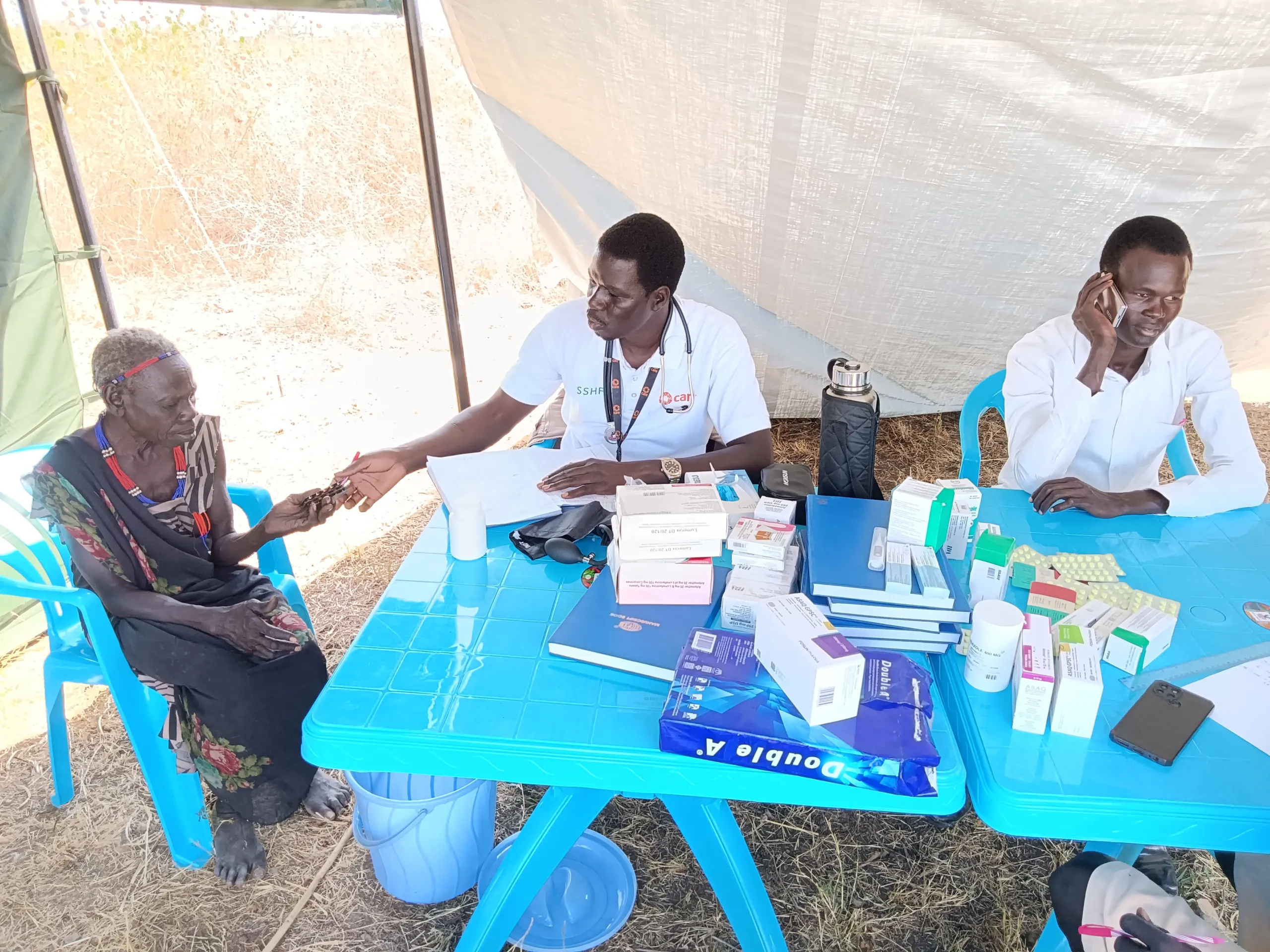
Abera Ngathira, 65, receives treatment and medication at a CARE mobile clinic in Mewun Paya
For the elderly, most of whom are living with physical weakness and chronic health challenges, the mobile clinics have brought relief much closer to home. Abera Ngathira, a 65-year-old widow from Mewun, lives with her four grandchildren and depends on her son, a farmer, for support.
Before the clinic was established nearby, she had to endure nearly five hours of walking to reach healthcare services in Boma whenever she became ill. One day, Abera developed severe fever, vomiting, and intense body pain. Weak and unable to travel far, she feared her condition would worsen. Her family brought her to CARE’s mobile clinic, where she received treatment free of charge.
“Because of my age, walking for many hours to Boma hospital was very difficult and risky. When I became seriously sick with fever, vomiting, and severe body pain, I thought my condition would worsen because I did not have the strength to travel far.
“But my family brought me to the mobile clinic nearby, where I received injections and treatment free of charge. Now I am healthy again and able to continue with my daily activities. I thank CARE International because this clinic has reduced suffering for older people like us,” said Abera.
Since the project began in December 2025, CARE’s mobile health teams have reached 15,256 people with critical healthcare services, including 415 people living with disabilities. In Upper Boma alone, approximately 4,667 people accessed healthcare services between December 2025 and February 2026. The mobile clinic currently serves four villages with an estimated population of 1,500 to 1,800 households.